
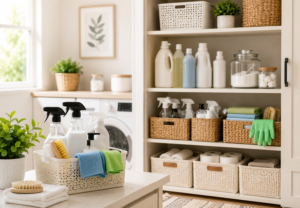
Direct answer
Organizing cleaning supplies is mostly about keeping hazardous products separated, stored correctly, and out of reach if children or pets are in the home. Beyond safety, the goal is a setup where you can find what you need quickly and know when something is running low. Most homes can get there with basic storage tools and a one-time sort through what’s actually being used.
Start by sorting what you have
Pull everything out before organizing anything. Check expiration dates, consolidate duplicates, and get rid of products you haven’t used in over a year. Cleaning supply clutter is usually half products that no longer get used.
While sorting, check every label for hazard warnings. Products marked flammable, corrosive, or toxic need to be stored differently than general cleaners. Set those aside.
Dispose of old or unwanted products properly. Most household cleaners can be poured down the drain with running water, but anything labeled hazardous should go to a local hazardous waste collection site. Pouring bleach, drain cleaners, or pesticides into regular trash creates a disposal problem. Check your municipality’s website for drop-off locations.
Never store these products together
Some common household cleaners react dangerously when they come into contact with each other. This matters most if containers leak or tip, which happens more often in cluttered storage than in organized storage.
Bleach and ammonia produce toxic chloramine gas when mixed. Ammonia is found in many glass cleaners, multi-surface sprays, and some floor cleaners. Keep these on separate shelves or in separate containers entirely.
Bleach and acidic cleaners like vinegar, some bathroom cleaners, and rust removers produce chlorine gas when combined. Bleach should be stored away from anything acidic.
Hydrogen peroxide and vinegar stored in the same container create peracetic acid, which is corrosive. Stored separately in their own bottles they’re fine, just don’t combine them.
The practical rule is to keep bleach-based products on their own shelf or bin, away from everything else. Most other general cleaners can be grouped together without concern.
Child and pet safety
If children or pets are in the home, any product that is toxic or caustic needs to be in a locked cabinet or stored high enough that it genuinely cannot be reached. A low cabinet under the sink with no lock is not adequate storage for bleach, drain cleaners, oven cleaners, or anything similarly hazardous.
Cabinet locks are inexpensive and install without tools on most cabinets. How to adjust cabinet doors that won’t close properly is worth checking first if the cabinet itself isn’t closing right before adding a lock.
Keep products in their original containers. Transferring bleach or a caustic cleaner into an unlabeled spray bottle or a bottle that previously held something else creates a serious identification problem, particularly in an emergency.
Where to store cleaning supplies
Under the kitchen sink works for everyday dish soap, surface sprays, and garbage bags. It’s convenient but often damp, which shortens the shelf life of some products and can cause label deterioration. Keep moisture-sensitive products elsewhere.
A dedicated cleaning caddy keeps the supplies you use most often portable and together. Useful if you clean multiple rooms rather than storing everything in one spot. Carry it with you rather than making multiple trips back to a central storage point.
A utility closet or laundry room shelf is the best location for bulk supplies, hazardous products, and anything used less frequently. Higher shelves for hazardous products, lower and more accessible for everyday items.
The garage or outdoor storage works for products like deck cleaners, car cleaning supplies, and pesticides, but only if temperatures stay within the range listed on the label. Many cleaning products degrade in extreme heat or cold. Check labels before storing anything in an uninsulated garage.
How to organize the storage itself
Group by use rather than by product type. Bathroom cleaners together, kitchen cleaners together, floor care together. This makes finding what you need faster than organizing by brand or alphabetically.
Use a lazy Susan on deep shelves so products at the back are reachable without pulling everything forward. A shallow bin or tray on each shelf keeps bottles from tipping and makes it easy to pull the whole group out at once.
Store spray bottles nozzle-side up or hang them on a tension rod installed inside a cabinet door. This prevents leaking from caps that aren’t fully closed and keeps the cabinet floor cleaner.
Label shelves if more than one person uses the storage. A simple label for each zone removes the guesswork and keeps things from drifting back to the wrong spot over time.
Products that need specific storage conditions
Flammable products like some furniture polishes, aerosol sprays, and certain degreasers should be kept away from heat sources, open flames, and direct sunlight. Do not store them near the stove, water heater, or in a hot garage.
Concentrated products that get diluted before use should be clearly labeled as concentrated and stored separately from ready-to-use sprays. Accidentally using a concentrated cleaner at full strength on the wrong surface causes damage that is usually avoidable.
Aerosol cans should never be stored near heat. The pressure inside increases with temperature and can cause the can to rupture. Keep them at room temperature and out of direct sunlight.
Maintenance once it’s organized
Do a quick check every few months. Toss anything expired, consolidate anything running low into one container, and make sure hazardous products are still properly separated. The organization degrades slowly over time if it isn’t occasionally reset.
A running list of what’s stored, kept on the inside of the cabinet door, makes it easier to restock before something runs out completely rather than discovering it mid-clean.