Direct answer
A home first aid station is a designated, stocked location for handling minor injuries and medical situations without searching through multiple drawers and cabinets. It doesn’t need to be elaborate. A single organized kit in a consistent location, stocked with the right supplies and maintained regularly, covers the vast majority of household medical situations.
This post covers general first aid supply recommendations for minor household injuries. It is not medical advice. For serious injuries, medical emergencies, or questions about specific health conditions or medications, consult a doctor or call emergency services.
Where to put it
The location matters as much as what’s in it. A first aid station that’s hard to find or access in a hurry defeats the purpose.
The most practical location for most households is a bathroom cabinet or a dedicated shelf in a linen closet. It should be accessible to adults quickly, away from direct heat and humidity which degrade supplies faster than most people expect, and out of reach of young children if the household has them. A cabinet with a latch or a high shelf accomplishes both.
Every adult in the household should know exactly where the kit is without having to search. If there are multiple floors, a small secondary kit on each level saves time for common situations like a kitchen cut or a bathroom scrape.
What to stock
A complete home first aid station covers four categories of need: wound care, pain and fever, common illness and digestive issues, and tools. Everything beyond those four categories is useful but not essential for a basic setup.
Wound care:
Adhesive bandages in multiple sizes including knuckle and fingertip bandages which are the most-used sizes in most households. Sterile gauze pads in two and four inch sizes for larger wounds. Medical adhesive tape to secure gauze. Rolled gauze for wrapping. Antiseptic wipes or a bottle of hydrogen peroxide for cleaning wounds. Antibiotic ointment like Neosporin to reduce infection risk. Butterfly closure strips for holding the edges of deeper cuts together. Medical grade super glue or skin closure strips for small deep cuts that don’t need stitches but need to stay closed.
Pain, fever, and inflammation:
Adult and pediatric doses of acetaminophen and ibuprofen if children are in the household. Aspirin for adults, noting that aspirin should not be given to children. An instant-read digital thermometer. A cold pack, either a reusable gel pack kept in the freezer or a single-use instant cold pack stored in the kit.
Common illness and digestive:
Antidiarrheal medication. Antacid tablets. Antihistamine for allergic reactions. Oral rehydration salts or packets for dehydration from illness. Cough suppressant and decongestant if preferred, though these are more optional than the others.
Tools:
Tweezers with a fine point for splinters and debris. Medical scissors or bandage scissors. Nitrile gloves, at least two pairs, for handling wounds without contamination. A magnifying glass for examining small wounds or splinters. A penlight or small flashlight for examining eyes, ears, and throats. A SAM (Structural Aluminum Malleable) splint for immobilizing potential sprains or fractures until professional care is available. An elastic bandage wrap for sprains and to secure splints or ice packs.
Medications to keep on hand separately
Prescription medications and a few specific over-the-counter items are better stored separately from the first aid kit rather than inside it, but they’re worth noting as part of a complete home medical setup.
If anyone in the household has a known severe allergy, an epinephrine auto-injector should be immediately accessible and every adult in the household should know where it is and how to use it. This is not stored in a cabinet out of reach. It needs to be accessible within seconds.
Prescription medications for chronic conditions should have a minimum three to seven day buffer supply where the prescription allows.
How to organize it
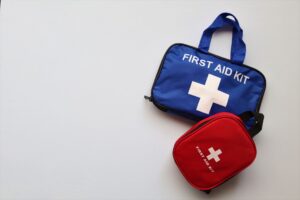
A pre-assembled kit from a pharmacy is a reasonable starting point since it covers most of the wound care basics and comes in a labeled container. The problem with most pre-assembled kits is that they include too many bandages in sizes that rarely get used and leave out items like butterfly closures, skin glue, and oral rehydration salts that are more useful. Use the pre-assembled kit as a base and add what’s missing.
If building from scratch, a clear plastic bin with a lid, a tackle box, or a labeled zippered pouch all work. Clear containers make it easier to see what’s running low without opening everything.
Organize by category rather than storing everything loose. A small pouch or zip bag for wound care supplies, one for medications, one for tools. This speeds up finding what’s needed in a stressful moment and makes restocking easier since depleted categories are obvious at a glance.
Label everything that isn’t immediately identifiable. Unlabeled packets and foil-wrapped items slow things down when someone is trying to find something quickly.
What goes in the kit versus what doesn’t
A home first aid station handles minor injuries, common illness, and stabilization while waiting for professional care. It is not a substitute for emergency medical services.
Items that don’t need to be in a basic home kit: prescription medications beyond a personal emergency supply, professional-grade wound closure supplies like surgical staples, large volumes of IV supplies, or anything requiring training to use safely. A basic kit stocked and maintained correctly handles what it’s designed for. Overstocking creates clutter and makes finding essential items harder.
Check expiration dates twice a year
Medications expire and lose effectiveness. Adhesive bandages dry out. Antiseptic wipes evaporate if the packaging is compromised. A kit that hasn’t been reviewed in two years likely has expired medications and degraded supplies.
Check the entire kit twice a year and replace anything expired or depleted. Spring and fall align with the seasonal cleaning routine and work well as consistent check-in points. Replace medications before they expire rather than after, since an expired pain reliever at midnight when someone has a fever is a problem that could have been avoided.
Restocking after use is the other maintenance habit worth building. If something gets used, replace it before the next time it’s needed rather than waiting for the twice-yearly check. A first aid kit with known gaps is less useful than one that’s consistently complete.
Keep a simple handwritten list of what the kit contains and the expiration dates of the medications taped to the inside of the lid. This makes the twice-yearly check faster and removes any guessing about what should be there.