Direct answer
Kitchen drawers stay organized when every item has a designated spot and the layout matches how the kitchen actually gets used. The fix for most disorganized kitchen drawers is removing what doesn’t belong, adding dividers, and assigning categories based on where things are used rather than where they fit.
Pull everything out first
The same rule applies here as with any organizing project. Empty every drawer before deciding what goes where. This gives you an accurate count of what you have, surfaces duplicates, and forces decisions about items that have been sitting unused at the back of a drawer for years.
Most kitchen drawers have at least a few things that don’t belong there: random hardware, expired coupons, takeout menus, broken tools that never got thrown out. Deal with those before organizing what stays.
Assign each drawer a category based on use
The most functional drawer layout puts items closest to where they get used. This sounds obvious but most kitchen drawers are organized by what fits rather than by workflow.
Cutlery drawer belongs nearest the dishwasher or drying rack since that’s where utensils land after washing, and nearest the table if the kitchen opens to a dining area.
Cooking tools drawer for spatulas, tongs, whisks, and wooden spoons belongs closest to the stove. Reaching across the kitchen for a spatula while something is cooking on the stove is a layout problem, not a storage problem.
Prep tools drawer for peelers, can openers, measuring spoons, and similar items belongs near the main prep area or cutting board location.
Junk drawer, if you keep one, belongs somewhere out of the primary workflow. More on this below.
Specialty or rarely used items like extra sets of measuring cups, baking tools, or seasonal gadgets belong in the least accessible drawer since they don’t need to be reached frequently.
Use dividers in every drawer
An open drawer without dividers becomes disorganized within days regardless of how well it was sorted to start. Dividers create fixed zones that items return to naturally.
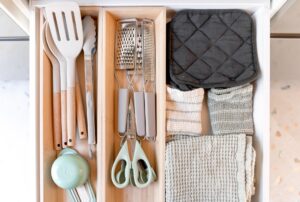
Adjustable bamboo or plastic drawer dividers work in most standard kitchen drawers and don’t require any installation. Set them to create sections sized for the specific items going in that drawer rather than equal sections across the whole drawer.
For the cutlery drawer, a fitted cutlery tray is more practical than adjustable dividers since the slots are sized specifically for forks, knives, and spoons. Measure the drawer before buying one since standard trays don’t fit all drawer sizes.
For cooking tool drawers where items are larger and more varied, dividers that create two or three sections keep categories separated without over-compartmentalizing.
The cutlery drawer specifically
Keep only what gets used regularly. Most households have more cutlery than they use daily. Extra sets, specialty pieces, and formal cutlery used only occasionally store better in a separate location than crowding the everyday drawer.
If the cutlery tray doesn’t fill the full depth of the drawer, the space behind it is useful for small items like a can opener, bottle opener, or kitchen scissors rather than leaving it empty or stuffed with random items.
The cooking tools drawer
This is the drawer that gets disorganized fastest because the items are large, varied, and used constantly. A few things that help:
Keep only tools that get used at least weekly. Specialty gadgets used twice a year don’t belong here. Store those elsewhere and free up space for what actually gets reached for daily.
Stand items upright in sections rather than laying everything flat. A deep drawer with dividers creating two or three vertical sections holds more tools accessibly than the same drawer with everything laid flat in layers.
If the drawer is too shallow for upright storage, a countertop utensil holder near the stove handles the most-used tools better than a crowded drawer.
The junk drawer
Most households have one and it serves a real purpose as a home for things that don’t belong anywhere else but need to stay accessible. The problem is usually that it expands to collect everything rather than staying limited to genuine miscellaneous items.
A contained junk drawer works better than no junk drawer. Use a small bin or a few dividers to create loose sections: batteries and small electronics, pens and notepads, basic hardware like loose screws and picture hooks, and miscellaneous items. This keeps the drawer functional without letting it become a dumping ground for everything.
Go through it every few months and remove anything that has accumulated without a real reason to be there.
Drawer space for non-utensil items
Kitchen drawers often store more than tools. A few specific situations worth addressing:
Plastic bag and wrap storage: A drawer designated for plastic bags, foil, plastic wrap, and parchment paper works better than a cabinet since these items are awkward to stack. A tension rod installed vertically inside the drawer holds rolls upright so they don’t unroll or collapse against each other.
Spice drawer: If cabinet space is limited, a shallow drawer near the stove with spices stored label-up in a single layer is one of the most functional spice storage options available. Every label is visible without moving anything. This works best in a drawer that’s at least two inches deep.
Towel and cloth drawer: A dedicated drawer for dish towels, cloths, and small kitchen linens keeps them accessible without taking up counter or cabinet space.
What makes kitchen drawers fail long term
Putting things back in the wrong drawer. Once categories are assigned, consistency is what keeps the system working. If multiple people use the kitchen, a quick label on the outside of each drawer removes the guesswork.
Keeping too much. Kitchen drawers have limited space and fill up fast. If a drawer is consistently overflowing, the problem is usually volume rather than organization. Pare down what’s being stored before adding more dividers.
Buying organizers before sorting. Organizers bought before knowing exactly what’s going in a drawer often don’t fit the actual items or leave awkward gaps. Sort first, measure the drawer, then buy dividers sized for what you actually have.