
Short Answer: Dividing household tasks fairly starts with listing everything that needs to be done, accounting for each person’s schedule and capacity, and agreeing on a system that both people can actually follow. Most household task conflicts come from mismatched expectations rather than unwillingness to help. A visible, agreed-upon system removes most of that friction.
List every task before dividing anything
Most disagreements about household labor happen because one person is aware of tasks the other doesn’t register as tasks at all. Restocking toilet paper, wiping down the stovetop, scheduling appliance maintenance, and buying cleaning supplies are all work, but they’re invisible until they don’t happen.
Write down every recurring task in the household across all categories: cleaning, cooking, laundry, grocery shopping, home maintenance, finances, and household admin like scheduling repairs or managing subscriptions. This list will be longer than expected. That’s the point. Both people seeing the full scope of what the household requires is the starting point for a fair division.
Account for time, frequency, and mental load
Not all tasks are equal. Cooking dinner every night is a different commitment than cleaning the bathroom once a week. Dividing tasks by count rather than by actual time and effort produces an imbalanced split that feels unfair even if the numbers look even.
For each task, note roughly how long it takes and how often it needs to happen. This gives a clearer picture of actual workload rather than task volume.
Mental load is part of the equation too. Remembering to schedule the HVAC service, noticing when cleaning supplies are running low, and tracking what’s in the refrigerator before grocery shopping all take cognitive effort. These tasks often fall disproportionately on one person and don’t show up on a basic chore list. They should.
Factor in each person’s schedule and capacity
A fair split isn’t always an equal split. If one person works longer hours, travels frequently, or has physical limitations, the division needs to reflect that rather than defaulting to a 50/50 that doesn’t match reality.
The goal is that each person’s contribution feels proportional to their capacity, not identical in volume. A person working 60-hour weeks contributing less to daily cleaning while taking on more weekend tasks or handling household finances is a fair arrangement even if task counts don’t match.
Capacity also changes. A busy work period, illness, or a new baby shifts what each person can reasonably handle. Building flexibility into the system from the start means it can adjust without requiring a full renegotiation every time something changes.
Assign tasks by preference and competence where possible
Some tasks have a natural owner because one person does them better, faster, or simply minds them less. Assigning those tasks to that person isn’t unfair, it’s efficient. The person who cooks well and enjoys it cooking most meals while the other person handles cleanup is a reasonable arrangement if both people are comfortable with it.
Preference-based assignment works best when the overall load is still balanced. If one person ends up with all the tasks they dislike because the other claimed every task they enjoy, the system will create resentment regardless of how it was framed.
For tasks neither person wants, rotate them or split them by week rather than permanently assigning them to one person.
Choose a format that’s visible to both people
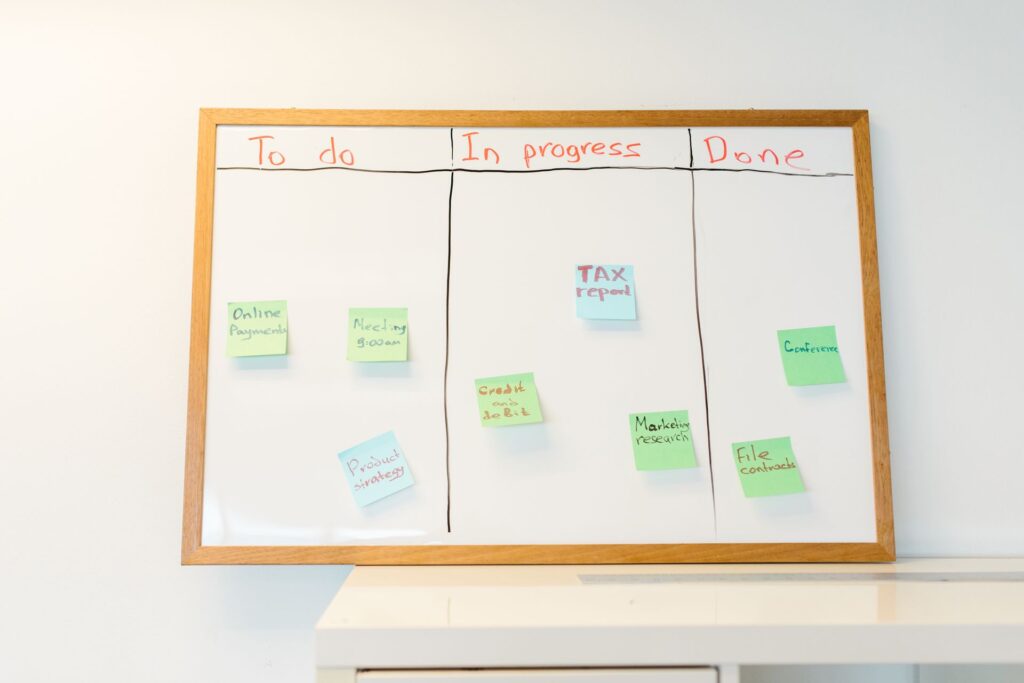
A division of tasks that exists only as a verbal agreement breaks down quickly. A shared list, a whiteboard on the refrigerator, or a simple shared note on a phone gives both people a reference point and removes the “I didn’t know that was my job” problem.
The format doesn’t need to be elaborate. A simple list with each task, who owns it, and how often it happens is enough. What matters is that it’s visible and that both people agreed to it rather than one person assigning it.
A shared calendar works well for tasks with specific timing, like taking out trash on collection day, changing the air filter monthly, or running the dishwasher before bed.
Review it periodically
A task division that worked six months ago may not fit current circumstances. Schedules change, new tasks come up, and some arrangements turn out to be more burdensome than they looked on paper.
A brief check-in every few months, not a full renegotiation but a quick conversation about what’s working and what isn’t, keeps the system from quietly becoming one-sided over time. The person who feels the system isn’t working is usually carrying tasks that weren’t fully accounted for in the original list.
What doesn’t work
Keeping score in real time. Tracking who did what last and using it as leverage in individual conversations turns a practical system into a competition. The goal is a system that feels fair overall, not a perfectly balanced ledger for every week.
Assuming the other person notices what you notice. Visibility of household tasks varies significantly between people and isn’t a reflection of care or effort. The list-making step exists precisely because assuming shared awareness doesn’t work.
Assigning tasks without agreement. A division one person created and handed to the other isn’t a shared system. Both people need to be part of building it for it to hold up.
Letting the system go unreviewed for too long. Life changes and a rigid system that doesn’t adapt creates resentment faster than no system at all.